Soap industry in India 2026 remains one of the most stable and deeply entrenched segments of the FMCG landscape. Soap is not a discretionary product in India; it is a daily essential across households, institutions, and public spaces. From bathing soaps and handwash bars to medicated and herbal variants, soap consumption cuts across income levels, geographies, and age groups.
What defines the soap industry in 2026 is high-volume consistency with gradual value upgrading. Volumes continue to be driven by mass-market products, while value growth is coming from premiumisation, herbal formulations, skin-care positioning, and liquid handwash extensions. Hygiene awareness that intensified after the pandemic has now become a long-term behavioural norm rather than a temporary spike.
This article examines the size of India’s soap industry in 2026, the factors driving its growth, the challenges shaping the sector, and how the industry is expected to evolve in the coming years.
Quick Overview: Soap Industry in India (2026)
| Aspect | Status |
| Total industry size | ₹22,000–24,000 crore |
| Annual growth rate | ~6–7% |
| Organised sector share | ~85% |
| Key product segments | Bathing soaps, handwash, medicated |
| Rural contribution | ~45% of volumes |
| Price sensitivity | High |
| Key growth lever | Premium & herbal soaps |
| Industry nature | Volume-led, brand-driven |
Industry Size and Structure (2026)
By 2026, India’s soap industry is estimated to be worth ₹22,000–24,000 crore, making it one of the largest personal care categories in the country. The market primarily includes bathing soaps, with handwash bars and medicated soaps forming smaller but important sub-segments.
The industry is highly organised and brand-dominated, with a handful of large FMCG companies accounting for the majority of sales. Unlike many other FMCG categories, the unorganised sector plays a limited role, mostly confined to local or niche herbal products.
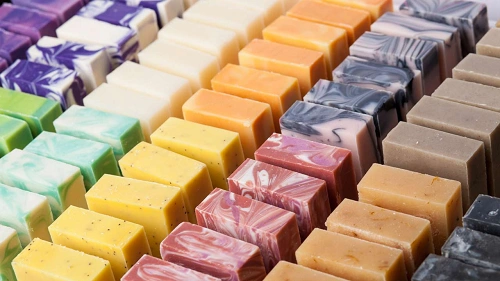
Broadly, the soap market can be divided into:
- Popular and economy soaps, priced for mass consumption
- Premium soaps, focused on fragrance, moisturisation, and skin benefits
- Herbal and ayurvedic soaps, positioned around natural ingredients
- Medicated soaps, targeting specific skin conditions
Economy and popular soaps continue to drive volumes, while premium and herbal soaps drive incremental value growth.
Key Growth Drivers in 2026
1. Hygiene as a Permanent Habit
Regular handwashing and bathing habits have become deeply ingrained across urban and rural India. Soap usage frequency has stabilised at a higher base than pre-2020 levels, supporting consistent demand.
Institutional usage in schools, offices, healthcare facilities, and public places also contributes to steady consumption.
2. Population Growth and Rural Demand
India’s large and growing population ensures baseline demand for soap. Rural markets, which account for nearly half of total volumes, remain critical to industry stability.
Small pack sizes and affordable price points are essential for maintaining rural penetration.
3. Premiumisation and Skin-Care Positioning
Urban consumers increasingly view soaps not just as cleansing agents but as personal care products. Moisturising, fragrance-rich, and skin-friendly soaps are gaining share in cities.
This shift allows brands to command higher margins without large increases in volume.
4. Growth of Herbal and Natural Products
Herbal soaps made with neem, aloe vera, sandalwood, and essential oils continue to attract consumers seeking “chemical-free” alternatives. This segment benefits from India’s strong ayurvedic and natural wellness heritage.
While still smaller than mainstream soaps, herbal variants are growing faster than the category average.
5. Expansion of Liquid Handwash Adjacent to Soaps
Although liquid handwash is a separate category, its growth supports hygiene awareness and indirectly reinforces soap consumption habits. Many consumers use both formats for different use cases.
Segment-wise Performance
a. Economy and Popular Soaps
This segment dominates volumes, especially in rural and low-income urban households. Pricing is highly competitive, and margins are thin.
Growth is steady but largely volume-driven.
b. Premium Soaps
Premium soaps focus on fragrance, moisturisation, and brand imagery. Growth is faster in urban markets, supported by higher disposable incomes and aspirational consumption.
c. Herbal and Ayurvedic Soaps
This segment continues to gain traction, especially among health-conscious consumers. Brand trust and ingredient transparency play a key role.
d. Medicated Soaps
Medicated soaps cater to specific skin conditions such as acne or fungal infections. Demand is stable but niche, influenced by dermatological advice.
Competitive Landscape
India’s soap industry is intensely competitive but well-established. Large FMCG companies dominate shelf space, advertising, and distribution, while regional brands compete on price and local relevance.
Competition is shaped by:
- Brand recall and trust
- Pricing and pack-size strategy
- Distribution reach
- Fragrance and formulation differentiation
Advertising plays a crucial role, as soaps rely heavily on brand perception and habit formation.
Key Challenges in 2026
1. High Price Sensitivity
Soap is a low-ticket essential. Even small price increases can impact demand, especially in rural and price-sensitive segments.
Maintaining margins without hurting volumes remains a constant challenge.
2. Rising Input Costs
Key inputs such as palm oil derivatives, packaging materials, and fragrances have seen price volatility. Passing these costs on to consumers is difficult in a competitive market.
3. Intense Brand Competition
The market is crowded, with frequent product launches and promotional activity. Sustaining differentiation and loyalty requires continuous investment in branding.
4. Environmental and Packaging Concerns
Growing scrutiny around plastic packaging and sustainability is pushing brands to rethink wrappers and supply chains, often at higher costs.
5. Limited Scope for Volume Expansion
Per-capita soap consumption is already relatively high. Future growth depends more on value enhancement than volume increase.
Structural Shifts Visible in 2026
Several long-term trends are shaping the soap industry:
- Gradual shift from basic cleansing to skin-care benefits
- Faster growth of premium and herbal soaps
- Continued dominance of organised brands
- Greater focus on sustainable packaging
- Increased role of rural distribution efficiency
The industry is evolving steadily rather than undergoing disruption.
Forecast: Soap Industry Outlook (2026–2030)
Short-Term Outlook (2026–2027)
- Stable growth driven by population and hygiene habits
- Margin pressure from raw material costs
- Incremental gains from premium and herbal segments
Medium-Term Outlook (By 2030)
By 2030, India’s soap industry could reach ₹30,000–32,000 crore in size. Growth will depend on:
- Continued premiumisation in urban markets
- Expansion of herbal and skin-care oriented products
- Cost management and supply chain efficiency
- Sustainable packaging innovation
Value growth is expected to outpace volume growth over the medium term.
Final Perspective
In 2026, India’s soap industry is quietly resilient and structurally sound. It may lack the excitement of emerging categories, but its scale, consistency, and deep consumer penetration make it one of the most dependable FMCG segments.
The future of the industry lies in elevating a basic necessity into a differentiated personal care experience, without losing the affordability and accessibility that define soap consumption in India.