Silk industry in India 2026 is undergoing its most meaningful transformation since the post-Green Revolution era. What was once viewed as a heritage-driven, labour-intensive cottage sector is now evolving into a strategic agro-textile industry backed by technology, import substitution, and export-oriented premiumisation.
Silk today sits at the intersection of rural livelihoods, women empowerment, global fashion, and sustainability-led trade. The defining shift of 2026 is not merely higher output or better prices — it is the structural strengthening of the entire value chain, from mulberry farms and tribal forest belts to European luxury boutiques.
For the first time in decades, India is reducing its dependence on imported Chinese silk, improving domestic yarn quality, digitising farmer price discovery, and restoring dignity in traditionally exploitative production practices. This marks a turning point where silk becomes not just cultural capital, but economic and strategic capital.
Quick Overview: Silk Industry in India (2026)
| Indicator | 2026 Status |
| Industry size | ₹27,000–₹32,000 crore |
| Annual growth rate | ~9–11% CAGR |
| Export share | ~28–30% of output value |
| Key silk types | Mulberry, Tasar, Eri, Muga |
| Import dependence | Sharply declining (Bivoltine surge) |
| Employment | ~5–6 million (direct & allied) |
| Key producing states | Karnataka, Andhra Pradesh, Tamil Nadu, West Bengal, Assam |
| Strategic focus | Import substitution + traceability + premium exports |
Industry Size and Structure (2026)
India remains one of the world’s largest silk producers, but what differentiates 2026 from earlier years is quality parity with global benchmarks. The industry’s total value — including sericulture, reeling, weaving, processing, and finished silk products — is estimated at ₹27,000–₹32,000 crore.
Mulberry silk continues to dominate volumes, but Vanya silks (Tasar, Eri, Muga) are gaining strategic importance due to their sustainability credentials and premium acceptance in global markets. The industry structure is still highly decentralised, with strong regional clusters, but coordination and standardisation have improved significantly.
Exports now contribute close to 30% of total value, not through raw silk alone, but through finished garments, scarves, saris, and designer fabrics.
Growth Drivers in 2026
1. The Import-Substitution Breakthrough
The most important structural shift in 2026 is India’s success in reducing reliance on Chinese silk.
A 297% jump in high-quality Bivoltine silk output during 2025–26 has allowed Indian weavers to source international-grade yarn domestically for the first time at scale. This has directly lowered costs, reduced lead times, and insulated weavers from global price shocks.
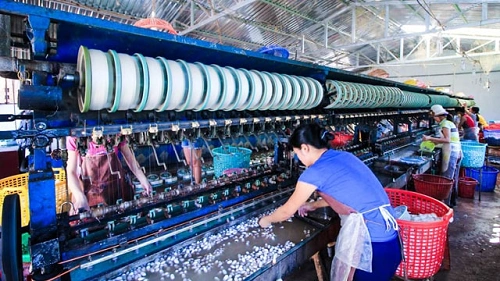
A critical enabler has been the ARM (Automatic Reeling Machine) initiative under Atmanirbhar Bharat. With ARM now fully scaled across major clusters, Indian silk yarn has achieved the uniformity, strength, and finish previously associated only with imported silk.
This is a structural win — not a cyclical one.
2. Digitalisation via the SILKS Portal
The industry’s move onto a GIS-enabled digital backbone marks another 2026 milestone.
The SILKS Portal uses satellite imagery and geographic data to identify new mulberry cultivation zones, enabling better land-use planning and climate resilience. This has helped expand sericulture into non-traditional but suitable regions.
More importantly, real-time cocoon and raw silk prices are now pushed directly to farmers’ mobile phones via SMS. This has significantly weakened the grip of intermediaries, improved farmer realisations, and brought transparency into a historically opaque market.
Digitalisation has turned sericulture from an intuition-based activity into a data-guided rural enterprise.
3. Export Premiumisation and “Farm-to-Fashion” Demand
Global demand for traceable, ethical, and sustainable textiles is driving premiumisation of Indian silk.
European and US buyers increasingly prefer silk that can demonstrate origin, ethical labour practices, and environmental compliance. Indian brands and exporters that integrate Silk Mark certification with emerging blockchain-based digital product passports are commanding 20–30% price premiums.
Designer collaborations, limited-edition collections, and heritage storytelling have further lifted export realisations.
4. Social Impact and Vanya Silk Transformation
A significant human-centric transformation is underway in tribal silk belts.
The introduction of the ‘Buniyad’ reeling machine has replaced the degrading practice of thigh reeling in Tasar silk production. This has not only improved yarn consistency and quality but has restored dignity to women workers in regions like Jharkhand and Chhattisgarh.
This shift is redefining Vanya silk as both ethically superior and commercially viable, unlocking new export demand.
Key Challenges (2026 Reality)
1. Urbanisation and the “Age Gap”
The challenge is no longer lack of interest alone, but urbanisation pressure. In traditional hubs around Bengaluru and other urbanising regions, mulberry farmland is being converted into real estate, shrinking the raw material base.
This land-use conflict is structural and requires targeted zoning and incentive policies to preserve sericulture belts.
2. Water Stress and Climate Risk
Sericulture is increasingly threatened by depleting water tables, especially in South India. Mulberry cultivation is water-intensive, and erratic rainfall patterns have raised yield volatility.
As a result, drought-tolerant mulberry varieties have become a top R&D priority for the Central Silk Board in 2026.
3. Traceability Compliance Gap
While demand for traceable silk is rising, many MSMEs still lack the technical capacity for digital tracking, batch-wise documentation, and ESG reporting. Without aggregation and shared infrastructure, small producers risk exclusion from premium global markets.
4. Cost Pressures at the Cluster Level
Rising labour, energy, and logistics costs continue to squeeze margins, particularly for small weavers. Value capture remains skewed toward brands and exporters unless collective branding and fair-trade models expand further.
Regulatory and Policy Environment (2026)
Policy changes in 2025–26 have materially improved the operating environment.
The Jan Vishwas Bill 2025 decriminalised several minor provisions under the Central Silk Board Act, reducing compliance anxiety for MSMEs and encouraging formalisation.
At the same time, the government has retained protective customs duties — 15% on raw silk and 20% on silk fabrics — shielding domestic producers from dumping and volatile global prices.
Together, these measures balance ease of doing business with farmer protection.
Structural Shifts in the Silk Industry
By 2026, the industry is undergoing clear structural realignment:
Silk is shifting from import-dependent to self-reliant.
Production is becoming digitally guided rather than tradition-only.
Vanya silk is moving from subsistence craft to ethical premium export.
Farmer and worker dignity are becoming economic differentiators, not just social goals.
This marks the transition of silk from a legacy sector to a future-ready agro-luxury industry.
Forecast (2026–2030)
Short-Term (2026–2027)
Growth is expected to remain strong at ~9–11% CAGR, driven by import substitution, premium domestic demand, and export value expansion. Bivoltine silk output will continue to rise, reducing vulnerability to global supply disruptions.
Medium-Term (2028–2030)
By 2030, exports could account for 35%+ of industry value, with Indian silk positioned firmly in the global premium segment. Growth will increasingly be value-led rather than volume-led, supported by traceability, sustainability, and design innovation.
Strategic Takeaway
The winning strategy in 2026 is “Farm-to-Foreign” integration.
Producers and brands that:
- Secure raw material at the farm level
- Use digital tools for traceability and pricing
- Adopt ethical, dignified production practices
- Align with global sustainability expectations
are already seeing 20–30% higher price realisations.
India’s silk industry is no longer just protecting tradition — it is monetising trust, quality, and transparency. The future belongs to those who can turn heritage into a globally scalable, ethically premium product.