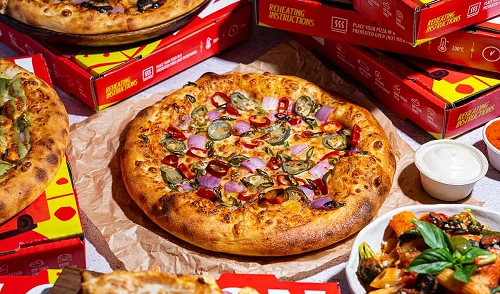
Pizza industry in India 2026 has firmly established itself as a mainstream pillar of modern food consumption, far removed from its earlier image as an occasional Western indulgence. What was once limited to weekend outings has now become a regular choice across lunch, dinner, late-night cravings, and group occasions.
Pizza today competes directly with traditional Indian meals and snacks, especially in urban and emerging city markets. The category spans value-driven quick bites, mid-range family meals, and premium artisanal experiences, all supported by strong digital ordering ecosystems.
What defines the pizza industry in 2026 is scale with speed and segmentation. Faster delivery expectations, health-forward positioning, and deeper penetration into Tier-2 and Tier-3 cities are reshaping how pizza brands operate, price, and expand.
This article breaks down the current size of India’s pizza industry in 2026, the key drivers behind its growth, the challenges it faces, and the outlook for the coming years.
Quick Overview: Pizza Industry in India (2026)
| Aspect | Status |
| Estimated industry value | ₹22,000–24,000 crore |
| Annual growth rate | ~10–12% |
| Organised sector share | ~55–60% |
| Primary consumption mode | Delivery-led |
| Key growth markets | Metros, Tier-2 & Tier-3 cities |
| Average order behaviour | Value bundles & combos |
| Industry phase | Speed-driven expansion |
Industry Size and Structure (2026)
By 2026, India’s pizza industry is estimated at ₹22,000–24,000 crore, covering dine-in outlets, delivery-focused QSR chains, cloud kitchens, and premium pizza concepts. While metros still account for the largest revenue share, growth momentum is clearly shifting outward.
The industry operates across four broad formats:
- Large organised pizza chains with national footprints
- Regional and city-based pizza brands
- Delivery-first cloud kitchens
- Premium and artisanal dine-in concepts
Delivery dominates volumes, but dine-in remains relevant for family outings and premium experiences.
Key Growth Drivers in 2026
1. On-Demand Delivery and the “20-Minute” Standard
A defining shift in 2026 is the industry’s move from the traditional 30-minute delivery promise to a 20-minute benchmark in dense urban clusters. This is being achieved through:
- Micro-kitchens placed closer to demand hotspots
- AI-driven predictive preparation, where dough is stretched and ovens are pre-heated based on demand forecasts
- Smarter order batching and rider allocation
Speed has become a competitive weapon, not just a service metric.
2. Youth, Convenience, and Social Consumption
Pizza remains closely linked to youth culture, casual gatherings, and shared meals. Its ability to serve groups quickly makes it a preferred option for offices, students, and families.
Localised flavours and vegetarian innovation continue to broaden appeal across regions.
3. Health-Forward Positioning Becomes Mandatory
In January 2026, stricter FSSAI labelling norms pushed the industry into a new phase. Health is no longer optional; it is now a baseline expectation.
Key responses from brands include:
- Millet-based and multigrain crusts, aligned with India’s broader millet push
- Transparent nutrition labels, showing per-slice calorie and sodium counts prominently on apps
- Reduced cheese, plant-forward toppings, and portion-controlled formats
While indulgence still sells, transparency now influences trust and repeat orders.
4. Expansion Beyond Metros: The Tier-2 & Tier-3 Shift
One of the most important structural changes in 2026 is the profitability shift toward Tier-2 and Tier-3 cities such as Surat, Nagpur, Indore, and Patna.
These markets often deliver:
- 20–25% lower real estate and operating costs
- Higher aspiration value, where pizza is still treated as a celebratory meal rather than a utility food
- Higher average order values (AOVs) compared to saturated metro markets
For many brands, store-level margins are now healthier outside the top metros.
Segment-wise Performance
a. Value and Entry-Level Pizza
This remains the largest segment by volume. Affordable pricing and combo offers drive frequency, especially in non-metro cities. Margins are thin but predictable.
b. Mid-Tier Pizza
The mid-tier category delivers the best balance of scale and profitability. Families and working professionals form the core customer base here.
c. Premium and Artisanal Pizza
Premium pizzas focus on ingredients, crust quality, and dining experience. Volumes are limited, but brand loyalty and pricing power are stronger.
d. Cloud Kitchens and Delivery-Only Brands
Cloud kitchens continue to grow by optimising for speed, app visibility, and cost efficiency. They play a major role in meeting the 20-minute delivery promise.
Competitive Landscape
The pizza industry in India is intensely competitive and platform-driven. Brands compete on:
- Delivery speed and reliability
- Pricing and promotions
- App visibility and ratings
- Consistency of taste and portion size
Customer loyalty is fragile, with discounts and delivery time often influencing choice more than brand identity.
Key Challenges in 2026
1. Input Cost Inflation
Cheese, wheat, vegetables, packaging, and fuel costs remain volatile. Passing these costs fully to consumers risks demand slowdown.
2. Delivery Economics Pressure
Faster delivery promises increase pressure on kitchen density, staffing, and rider availability. Execution errors directly impact customer trust.
3. Health Perception Risk
Despite healthier options, pizza still faces scrutiny in wellness-focused urban segments. Managing indulgence without alienating health-conscious consumers is a delicate balance.
4. Platform Dependence
Heavy reliance on delivery apps affects margins due to commissions and promotional costs. Building direct ordering remains a challenge.
Structural Shifts Clearly Visible in 2026
- Delivery speed as a brand differentiator
- Health transparency becoming non-negotiable
- Higher profitability in Tier-2 and Tier-3 cities
- Micro-kitchen and demand-prediction models
- Pizza shifting from “occasion food” to “planned convenience”
The industry is no longer growing just by opening stores—it is growing by engineering efficiency.
Forecast: Pizza Industry Outlook (2026–2030)
Short-Term (2026–2027)
- Continued double-digit growth
- Faster rollout in non-metro cities
- Greater focus on operational efficiency
Medium-Term (By 2030)
By 2030, India’s pizza industry could reach ₹40,000–45,000 crore, driven by:
- Deeper penetration in emerging cities
- Sustainable delivery economics
- Health-aligned product innovation
- Smarter use of data and predictive cooking
Value growth is expected to remain strong, even if volume growth moderates.
Final Perspective
In 2026, India’s pizza industry has entered its execution era. Growth is no longer about novelty—it is about speed, transparency, and local relevance.
Brands that master 20-minute delivery, health-forward menus, and Tier-2 city economics will define the next chapter of the category. Pizza in India has become less about indulgence alone and more about how efficiently modern food habits can be served at scale.