Jute industry in India stands at a decisive crossroads in 2026. Once sustained largely by regulation and legacy demand, the sector is now being reshaped by farm-level economics, raw material scarcity, and a sharp split between traditional sacking and modern technical applications. Sustainability tailwinds are real, but they are no longer enough on their own. The industry’s future now depends on how quickly it adapts to crop competition, pricing realities, and new-use markets.
What makes 2026 different is not a single policy announcement, but a set of hard economic signals: farmers switching crops, record-high raw jute prices, partial relaxation of mandated demand, and a clear breakout in jute geotextiles. This article lays out the current size and structure of the industry, the forces driving and constraining growth, and what the next phase is likely to look like.
Quick Overview: Jute Industry in India (2026)
| Indicator | 2026 Status |
| Total industry size | ₹55,000–60,000 crore |
| India’s share of global output | ~60–65% |
| Annual growth rate | ~5–7% |
| Raw jute price | ~₹11,000 per quintal |
| Major producing states | West Bengal, Assam, Bihar, Odisha |
| Organised mill base | ~70+ composite mills |
| Employment supported | ~4 million (direct & indirect) |
| Fastest-growing segment | Jute geotextiles |
| Industry phase | Structural stress + diversification |
Industry Size and Structure (2026)
India remains the world’s largest producer and exporter of jute in 2026, with an industry value estimated at ₹55,000–60,000 crore. The sector supports millions of livelihoods across farming, retting, spinning, weaving, and finished goods manufacturing. However, the internal economics of the industry have changed meaningfully.
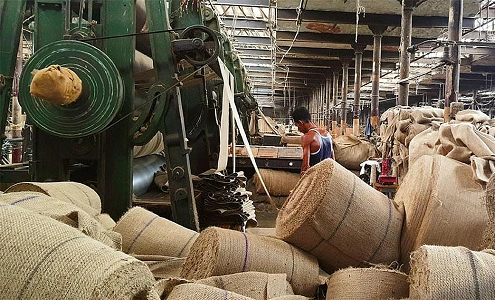
Production is still concentrated in eastern India, especially West Bengal, where large composite mills dominate. These mills historically relied on steady procurement of jute sacks for foodgrain packaging. While that demand continues, it is no longer the single stabilising force it once was. Cost pressures, raw material volatility, and policy flexibility have reduced the predictability of this segment.
At the same time, a parallel structure is emerging. Smaller, more agile players — along with some legacy mills — are moving into value-added products such as geotextiles, diversified packaging, handicrafts, and export-oriented applications. The industry is no longer monolithic. It is splitting between volume-led legacy operations and value-led modern segments.
Growth Drivers in 2026
1. Sustainability and Plastic Substitution
Environmental pressure on single-use plastics continues to support baseline demand for jute. Retailers, agricultural markets, and government procurement agencies increasingly prefer biodegradable alternatives. Jute’s natural fibre profile, renewability, and compostability give it a structural advantage in sustainability-driven procurement.
However, unlike earlier years, sustainability in 2026 acts more as a qualifier than a growth accelerator. It keeps jute relevant, but it does not guarantee profitability unless backed by efficient sourcing and product differentiation.
2. Export Demand and Eco-Packaging
Exports remain a steady growth pillar. Demand from Europe, North America, and parts of Asia for eco-friendly packaging, yarn, and floor coverings continues to rise. Importantly, export buyers increasingly prefer finished or semi-finished products over raw yarn, improving realisations for exporters who invest in design and compliance.
Export growth is strongest in segments where jute replaces plastic or synthetic fibres, particularly in lifestyle products and technical textiles.
3. Expansion of Jute Geotextiles
The most consistent growth engine in 2026 is jute geotextiles. These products are now widely used in rural road construction, riverbank stabilisation, erosion control, and landscaping. They align well with infrastructure development and environmental engineering needs.
Under programmes such as Pradhan Mantri Gram Sadak Yojana, jute geotextiles have moved from trials to standard application in many regions. Export demand has also picked up sharply, making this the most future-facing segment of the industry.
The Core Challenge: Raw Material Economics
The “Maize Shift” at the Farm Level
The most disruptive force in 2026 is not demand — it is supply.
In traditional jute-growing belts such as Cooch Behar in West Bengal, farmers are rapidly shifting acreage from jute to maize. The reasons are straightforward and economic:
- Higher yields per acre
- Less labour-intensive harvesting
- Faster cash cycles
- Assured demand from poultry feed and ethanol markets
This crop shift has reduced jute acreage and tightened raw material availability. As a result, raw jute prices surged to around ₹11,000 per quintal in late 2025, far above MSP levels and government cost assumptions.
For the industry, this has changed everything. Raw jute is no longer a stable, low-volatility input. It is a scarce commodity with pricing power at the farm gate.
Policy Environment and Demand Stability
The industry continues to operate under the framework of the Jute Packaging Materials Act, which mandates jute packaging for foodgrains. However, supply constraints have exposed the limits of mandate-led demand.
With raw jute availability under pressure, plastic alternatives have been allowed in parts of procurement to prevent disruptions. This has introduced a degree of uncertainty that did not exist earlier. Demand remains large, but it is no longer absolute or unconditional.
For mills, this reinforces a critical lesson: policy support cannot substitute for raw material security.
Operational and Structural Challenges
Margin Compression
High raw jute prices combined with capped or formula-driven bag prices have created a margin squeeze. Mills are selling into a strong demand environment, yet profitability is under stress. Working capital requirements have increased, and smaller mills are finding it harder to stay liquid.
Productivity and Modernisation
Many mills still operate with ageing machinery and low automation. Labour intensity remains high, and productivity gains are incremental at best. Without sustained capital investment, competing on cost and quality — especially for exports — remains difficult.
Quality Variability
Fibre quality continues to vary widely due to differences in retting practices, weather conditions, and farmer knowledge. While initiatives like improved retting techniques are helping, consistency remains a challenge, particularly for high-end applications.
Structural Shift: From “Sacks” to “Solutions”
By 2026, it is clear that the traditional sack-only model is under strain. The future of the jute industry lies in diversification:
- Technical textiles and geotextiles
- Jute composites for automotive interiors and insulation
- Lifestyle and fashion exports
- Blended materials and specialty applications
This transition is often described as “Jute 2.0” — a move from regulated volume to market-driven value.
Forecast: 2026–2030
Short-Term Outlook (2026)
The near term will be challenging for traditional mills. Demand remains strong, but rising raw material costs will continue to outpace pricing flexibility. Margin pressure and consolidation are likely.
Diversified and export-oriented players will perform better than pure sacking manufacturers.
Medium-Term Outlook (By 2030)
By 2030, the industry could exceed ₹80,000 crore in size if diversification accelerates. Growth will come less from sacks and more from:
- Geotextiles and infrastructure use
- Automotive and construction composites
- High-value exports in fashion and packaging
The industry’s success will depend on aligning farmer incentives, improving productivity, and building market-led demand beyond mandates.
Strategic Takeaway
In 2026, the jute industry is no longer protected by policy alone. Crop competition, raw material pricing, and changing demand structures have forced a reset.
The winners will be those who move early into value-added, exportable, and technical applications — and who treat jute not as a compulsory packaging material, but as a versatile, modern fibre.
Jute’s future is not guaranteed. But it is still very much buildable.