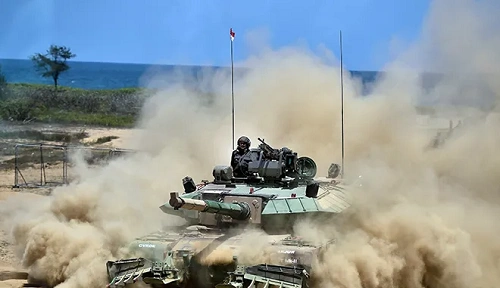
In 2026, India’s defence industry has evolved from a largely import-dependent sector into a strategic industrial base with strong indigenous manufacturing, growing private sector participation, and accelerating exports. The narrative of recent years — self-reliance, modernisation, and export orientation — is now taking shape in measurable outcomes: rising domestic production, deeper supply chains, and broader global demand for Indian systems.
However, the journey is not without pressure. Expectations have shifted from simply buying equipment to building it competitively at scale, integrating complex technologies, and delivering reliably on export commitments. With sustained government support, increasing private sector share, and maturing industrial ecosystems, the defence industry in India is at a critical inflexion point — driving growth today and positioning for far greater relevance in the next decade.
Quick Overview: Defence Industry in India
| Indicator | 2026 Status / Value |
| Annual defence budget (total outlay) | ~₹6.8 lakh crore |
| Capital modernisation budget | ~₹1.8 lakh crore |
| Domestic defence production | ~₹1.5 lakh crore annually |
| Defence exports | Record growth (FY26 value rising) |
| Recent major procurement approvals | ~₹79,000 crore package |
| Private sector share (production & exports) | Rapidly rising |
| Strategic export target | ₹50,000 crore by 2029 |
| Key growth segments | UAVs, missiles, naval systems, electronics, space-related defence |
Industry Size and Structure (2026)
In 2026, India’s defence industry stands among the largest in Asia, combining state, cooperative, and private manufacturing. Domestic production — driven by both public sector undertakings and an increasingly capable private base — totals roughly ₹1.5 lakh crore annually. This figure includes systems for the Army, Navy, Air Force, paramilitary and border security forces, as well as exports.
The total defence budget (all expenditure) is around ₹6.8 lakh crore, with a capital allocation of about ₹1.8 lakh crore. Capital outlays focus on modernisation — acquiring new platforms, upgrading technology, and building infrastructure. These figures place India among the top defence spenders globally, backed by slower but sustainable revenue trends.
Export performance is one of the most visible turnaround stories of the decade. From negligible values a few years ago, Indian defence exports have surged in value and diversity — including missiles, drones, radar systems, army vehicles, naval components, and electronic warfare equipment.
The industry has moved from being dominated by traditional Defence Public Sector Undertakings (DPSUs) to a mixed ecosystem where private firms, start-ups, MSMEs and tiered supply chains play increasingly central roles.
Growth Drivers in 2026
1. Scale and Stability in Government Spending
The single biggest driver of 2026 growth is predictable and robust defence expenditure. Capital allocations remain strong and multiple procurement packages — including a ~₹79,000 crore approval in late 2025 — give manufacturers and integrators a strong order book with multi-year visibility.
Many defence OEMs now operate like industrial corporations rather than project contractors, with predictable revenue pathways and sustained production runs.
2. Private Sector Emergence and Policy Support
A decade of policy reform — including offset policy evolution, easing of licensing, strategic partnerships and explicit preference for indigenous production — has broadened participation beyond DPSUs.
Modern private firms are now leading in:
- Unmanned Aerial Vehicles (UAVs)
- Electronic Warfare and communications systems
- Naval platforms
- Armoured vehicles and airborne systems
This diversification improves competitiveness and brings fresh investment and talent into the sector.
3. Export Orientation and Global Demand
Exports, once a marginal contributor, are now a significant revenue and strategic variable. India’s defence industry is competing in global markets — in Africa, Southeast Asia, the Middle East, and Latin America — with products such as:
- Loitering munitions
- Radars and communication suites
- Small naval systems
- Armoured vehicles
Export demand is being supported by targeted government facilitation, trade diplomacy, and global supply base re-alignment as buyers seek alternatives to traditional sources.
4. Technology Integration and R&D Focus
Emerging technologies — including AI for autonomy, electronic warfare, signal intelligence, autonomous navigation and mission software — are increasingly embedded in new systems. Defence start-ups and academia are collaborating on cutting-edge R&D, closing gaps that once required foreign partners.
This is especially visible in:
- Drone swarms and robotics
- Active protection systems
- Integrated battlefield management systems
These capabilities make Indian systems more competitive globally.
5. Tiered Supplier Ecosystem Building
The defence industry is building deeper domestic supply chains: small and medium enterprises now make structural components, electronics, software and subsystems — reducing dependence on expensive imports and improving control over quality and schedule.
Key Challenges in 2026
1. Execution and Systems Integration Risk
Defence systems are complex. Winning contracts is one thing; integrating subsystems, testing rigorously, and fielding reliable platforms is harder. Delays in integration, testing bottlenecks and certification timelines remain industry pain points.
Overcoming this requires stronger collaboration between OEMs, suppliers, test labs, and services.
2. Capital Intensity and Working Capital Stress
Defence manufacturing is capital-intensive. Suppliers, especially smaller firms, often face working capital pressure due to long receivable cycles and advance payment complexities. Access to affordable project finance remains uneven.
Solutions require targeted credit facilities, export credits, and supplier financing mechanisms.
3. Technology Import Dependence
Despite gains, India still sources:
- Advanced avionics
- RF modules
- Certain composite materials
- High-end processors
Developing indigenous alternatives in these critical nodes is a multi-year task and remains a structural vulnerability.
4. Export Compliance and Geopolitical Risk
Export growth is strong, but defence exports are sensitive. Geopolitical shifts, regulatory frameworks, and market access rules in importing countries introduce volatility. Producers must manage export compliance and diversify market footprints.
5. Talent and Skills Gap
Highly specialised domains (systems engineering, software and integration, certified manufacturing) require talent that India is just beginning to build at scale. Workforce upskilling remains a priority.
Structural Shifts in the Defence Industry
By 2026, the industry has shifted from:
- Import dependency to indigenous production
- Volume procurement to capability-led acquisition
- DPSU dominance to shared industry base
- Low export base to competitive export growth
- Manual, low tech supply chains to R&D-integrated systems
These structural changes reflect the maturation of India’s defence industrial base.
Forecast (2026–2030)
Short-Term (2026–2027)
- Defence production continues mid-to-high single-digit growth
- Exports expand as more products reach global markets
- Modernisation programs (air, sea, land) sustain capital contracts
Medium-Term (2028–2030)
- Indian systems become price-competitive with global peers
- Tier-1 and Tier-2 supplier base matures into export-ready clusters
- Indigenous technology share increases
- Defence exports approach government targets with better diversification
Overall Outlook:
Steady volume growth on defence production, higher growth in value and margin through exports and high-tech products.
Strategic Takeaway
In 2026 the Indian defence industry:
- Has scale and policy support
- Is structurally transitioning toward quality and value
- Has emerging global relevance
- Needs sharper execution and deeper technological autonomy
Private sector leadership in exports, cooperative supply chain building, and a focus on complex systems will define the next decade. If India can continue to integrate innovation with policy intent and industrial capacity, the defence sector is positioned to become a strategic economic engine and global exporter, not just a purchase destination for its own armed forces.