Automation industry in India has shifted from a niche efficiency tool to a core enabler of competitiveness across manufacturing, logistics, utilities, and services. Automation is no longer just about replacing manual steps; it is about improving consistency, reducing downtime, managing quality at scale, and responding faster to market demand. From factory floors and warehouses to power grids and process plants, automation is becoming embedded in how Indian industry operates.
What defines the automation industry in 2026 is breadth with depth. Adoption is spreading beyond large enterprises to mid-sized manufacturers and infrastructure operators, while technologies are moving from basic control systems to integrated platforms that combine sensors, software, data, and analytics. Growth is strong, but the path is shaped by skills availability, capital intensity, and the ability to integrate legacy systems.
This article examines the size of India’s automation industry in 2026, the forces driving adoption, the challenges shaping outcomes, and how the sector is likely to evolve over the next few years.
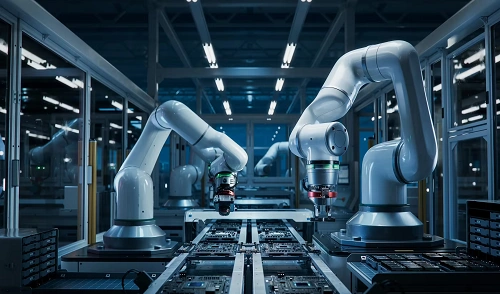
Quick Overview: Automation Industry in India (2026)
| Aspect | Status |
| Total industry size | ₹85,000–95,000 crore |
| Annual growth rate | ~12–14% |
| Core segments | Industrial, process, building automation |
| Key adopters | Manufacturing, logistics, energy |
| Technology mix | PLCs, SCADA, robotics, sensors |
| Software share | Rising steadily |
| Organised sector share | High |
| Industry phase | Expansion with integration focus |
Industry Size and Structure (2026)
By 2026, India’s automation industry is estimated at ₹85,000–95,000 crore, encompassing industrial automation hardware, control systems, robotics, instrumentation, software platforms, and integration services. The market includes both greenfield automation in new plants and brownfield upgrades across existing facilities.
The industry is structured across several layers:
- Field devices such as sensors, actuators, and drives
- Control systems including PLCs, DCS, and SCADA
- Robotics and motion control for discrete manufacturing
- Software and analytics for monitoring, optimisation, and predictive maintenance
- System integration and services, which bind components into working solutions
While hardware still contributes a large share of revenues, software and services are growing faster, reflecting the shift toward connected, data-driven operations.
Key Growth Drivers in 2026
1. Manufacturing Competitiveness and Cost Pressure: Indian manufacturers face intense competition on cost, quality, and delivery timelines. Automation helps reduce variability, improve yield, and manage labour dependence—especially important in sectors such as automotive, electronics, metals, chemicals, and pharmaceuticals.
Rising wages and the need for consistent quality are accelerating automation adoption beyond top-tier plants.
2. Expansion of Warehousing and Logistics: Growth in e-commerce, organised retail, and industrial distribution has driven demand for automated warehousing, material handling systems, and sorting solutions. Conveyors, automated storage and retrieval systems (ASRS), and robotics are increasingly common in large logistics hubs.
Speed, accuracy, and scalability are key drivers in this segment.
3. Infrastructure and Utilities Modernisation: Power generation, transmission, water treatment, and oil & gas facilities are adopting automation to improve reliability and safety. Smart substations, automated pumping stations, and remote monitoring systems are expanding across infrastructure projects.
These applications favour long-term, service-intensive automation deployments.
4. Process Industry Digitalisation: Process industries such as chemicals, cement, steel, and refineries are upgrading from basic control to integrated automation platforms. Advanced control, energy optimisation, and real-time monitoring are improving efficiency and compliance.
Lifecycle management and uptime optimisation are major value drivers here.
5. Push Toward Industry 4.0 Concepts: While full Industry 4.0 implementation remains selective, elements such as machine connectivity, condition monitoring, and data analytics are increasingly adopted. Companies are focusing on practical automation with measurable ROI, rather than experimental deployments.
Segment-wise Performance
Industrial Automation (Discrete Manufacturing)
This is the largest segment by value. Automotive, electronics, consumer goods, and engineering industries drive demand for PLCs, robots, and motion control systems.
Robotics adoption is growing, though still lower than global benchmarks.
Process Automation
Process automation serves continuous and batch industries. Demand is steady and project-driven, with long sales cycles but stable service revenues.
Upgrades and retrofits form a significant part of this segment.
Building and Facility Automation
Commercial buildings, data centres, hospitals, and campuses use automation for HVAC, lighting, security, and energy management. Growth is linked to real estate and data infrastructure expansion.
Software, Analytics, and Services
This is the fastest-growing segment. Monitoring platforms, predictive maintenance tools, and integration services are gaining share as customers seek end-to-end solutions.
Recurring service contracts are becoming more important.
Competitive Landscape
The automation industry in India is organised and technology-led. Global automation majors dominate high-end systems and platforms, while Indian firms are strong in panels, integration, and customised solutions.
Competition is driven by:
- Technology depth and reliability
- Integration capability
- After-sales service and lifecycle support
- Total cost of ownership
System integrators play a crucial role, especially in adapting global platforms to Indian operating conditions.
Key Challenges in 2026
1. High Capital Costs and ROI Sensitivity: Automation projects require upfront investment. Mid-sized firms often delay adoption due to long payback periods or uncertainty about demand stability.
Demonstrating clear ROI remains critical.
2. Skills and Talent Shortage: Automation requires engineers skilled in controls, software, networking, and data. Availability of such talent is uneven, particularly outside major industrial hubs.
Training and retention are persistent challenges.
3. Integration with Legacy Systems: Many plants operate legacy equipment. Integrating new automation with old systems can be complex, costly, and risky.
This slows adoption in brownfield facilities.
4. Cybersecurity Risks: As automation systems become connected, cybersecurity risks increase. Many industrial users lack mature security practices, exposing operational vulnerabilities.
5. Dependence on Imports for High-End Components: Advanced controllers, drives, and sensors are still largely imported. This exposes projects to currency fluctuations and supply chain disruptions.
Structural Shifts Visible in 2026
Several long-term shifts are reshaping the automation landscape:
- Move from hardware-only sales to solution-based offerings
- Rising importance of software and data analytics
- Gradual spread of automation to mid-sized enterprises
- Increased focus on energy efficiency and uptime
- Greater role of system integrators and service partners
The industry is evolving from equipment supply to operational enablement.
Forecast: Automation Industry Outlook (2026–2030)
Short-Term Outlook (2026–2027)
- Strong growth in manufacturing and logistics automation
- Increased demand for retrofits and upgrades
- Continued expansion of software and services
Medium-Term Outlook (By 2030)
By 2030, India’s automation industry could reach ₹1.6–1.8 trillion in size. Growth will depend on:
- Sustained industrial and infrastructure investment
- Adoption by mid-sized manufacturers
- Availability of skilled automation professionals
- Successful localisation of components
Value growth is expected to accelerate as automation becomes more integrated and service-led.
Final Perspective
In 2026, India’s automation industry is no longer optional it is foundational. As industries strive for efficiency, resilience, and quality, automation provides the tools to compete in a demanding global environment.
The next phase of growth will favour companies that combine technology, integration capability, and practical execution, helping Indian industry move from incremental automation toward smarter, more connected operations at scale.