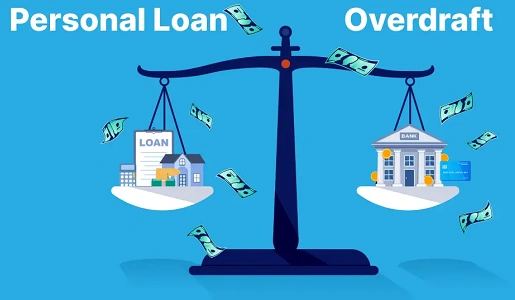
When money is needed beyond regular income, two common borrowing options often come into focus: Overdraft (OD) and Personal Loan. Both provide access to funds, both charge interest, and both are widely offered by banks and NBFCs. Yet they work in very different ways and suit very different financial needs.
Many people choose one simply because it is available or quick, without fully understanding the long-term cost and impact. That’s where problems begin. This detailed comparison explains every aspect—structure, cost, flexibility, risk, and real-life usage—so you can decide which option is truly better for you.
What Is an Overdraft (OD)?
An overdraft is a credit facility linked to your bank account. The bank allows you to withdraw more money than what is available in your account, up to a sanctioned limit. You pay interest only on the amount you actually use, and only for the period you use it.
OD facilities are commonly given to salaried individuals, professionals, and businesses. They are often backed by security such as fixed deposits, property, salary account, or business turnover.
What Is a Personal Loan?
A personal loan is an unsecured loan where you receive a lump sum amount upfront. This amount is repaid through fixed monthly EMIs over a predefined tenure.
Personal loans are not linked to your bank balance. Once disbursed, the full loan amount starts attracting interest, regardless of how or when you use it.
Core Structural Difference
The biggest difference lies in how the money is accessed and repaid.
- OD is a credit line that you dip into as needed
- Personal loan is a one-time disbursement with fixed EMIs
This single difference changes flexibility, cost behavior, and discipline.
Interest Calculation
Overdraft interest is calculated daily on the outstanding amount used. If you repay the amount partially or fully, interest reduces immediately.
Personal loan interest is calculated on a reducing balance, but the EMI structure is fixed. Interest starts on the full loan amount from day one.
For short-term or intermittent needs, OD can be cheaper. For long-term needs, personal loans are more predictable.
Interest Rates
OD interest rates are usually:
- Lower if secured (FD, property, salary OD)
- Higher if unsecured
Personal loan interest rates are generally higher than secured OD but lower than unsecured OD in many cases.
However, OD rates can fluctuate, while personal loan rates are usually fixed.
Repayment Structure
OD has no fixed EMI. You can repay anytime, in parts or fully. As long as interest is serviced and limits are respected, flexibility remains.
Personal loans have mandatory fixed EMIs. Missing EMIs leads to penalties and credit score damage.
OD offers freedom. Personal loans enforce discipline.
Loan Amount
OD limits depend on:
- Salary level
- Account relationship
- Security provided
Limits are often moderate.
Personal loans can offer higher amounts based on income and credit profile.
For large planned expenses, personal loans often provide better funding.
Tenure and Validity
OD facilities are usually sanctioned for one year and reviewed or renewed annually.
Personal loans have defined tenures, usually 1 to 5 years, sometimes longer.
OD works best for ongoing needs. Personal loans work best for defined goals.
Flexibility of Usage
OD is extremely flexible. You can withdraw, repay, and reuse funds multiple times within the limit.
Personal loans offer flexibility in purpose, but once used, the amount cannot be reused unless you take a new loan.
OD behaves like a financial buffer. Personal loans behave like a commitment.
Cash Flow Management
OD is ideal for managing short-term cash gaps, uneven income cycles, or emergencies.
Personal loans suit steady income earners who can manage fixed monthly payments comfortably.
For variable income, OD feels less stressful. For stable income, personal loans feel safer.
Cost Over Time
If OD is used continuously for long periods, interest cost can become high and unpredictable.
Personal loans may cost more upfront but provide cost certainty over the full tenure.
OD is cheaper when used briefly. Personal loans are cheaper when used long-term.
Credit Score Impact
OD impacts credit score based on:
- Utilization level
- Repayment behavior
High and continuous utilization can hurt credit.
Personal loans impact credit score through EMI discipline. Timely payments improve credit history.
OD requires self-control. Personal loans reward discipline.
Risk of Overspending
OD makes money feel easily available. This can lead to habitual overdrawing and poor financial discipline.
Personal loans, because of fixed EMIs, discourage casual borrowing.
Behaviorally, OD carries a higher risk of misuse.
Documentation and Approval
OD approval often requires:
- Strong banking relationship
- Security or salary linkage
Personal loans rely more on:
- Income proof
- Credit score
Personal loans are easier to get for many individuals. OD is easier to misuse once granted.
Tax Treatment
OD interest may be tax-deductible if used for business purposes and properly documented.
Personal loan interest is generally not tax-deductible, except in specific cases.
For business use, OD can be more tax-efficient.
Which Is Better for Emergencies?
OD is better for sudden, short-term emergencies where money is needed quickly and repaid soon.
Personal loans are slower and unnecessary for very short-term needs.
Which Is Better for Planned Expenses?
For weddings, medical treatment, education, or travel, personal loans are better due to structured repayment.
Using OD for large planned expenses can keep balances high for long periods.
Which Is Better for Salaried Individuals?
Salaried individuals with stable income often benefit from personal loans for clarity and predictability.
OD works well as a backup facility, not a primary borrowing tool.
Which Is Better for Self-Employed and Professionals?
OD suits self-employed individuals and professionals with uneven cash flow.
Personal loans may feel restrictive during low-income months.
Key Limitations Summary
OD Limitations
- Encourages overspending
- Unclear long-term cost
- Annual renewal risk
Personal Loan Limitations
- Fixed EMI pressure
- Higher cost for short-term needs
- No reuse of funds
Conclusion
There is no universal winner between OD and personal loan. An overdraft is better when you need flexibility, short-term access, and interest savings on unused funds. A personal loan is better when you need a fixed amount, long-term planning, and disciplined repayment.
The smartest approach is often to use OD as a safety net and personal loans for defined goals. Borrowing becomes dangerous not because of the product, but because of mismatch between need and structure. Choose the one that fits your cash flow, not just your convenience.