Warehousing industry in India 2026 has moved from being a back-end storage function to a core pillar of the country’s logistics and consumption economy. Warehouses today are not just godowns; they are technology-enabled distribution hubs that power e-commerce, manufacturing, retail, agriculture, and exports. Faster delivery expectations, GST-led supply chain redesign, and the rise of organised retail have fundamentally reshaped the sector.
What defines the warehousing industry in 2026 is scale with sophistication. Capacity has expanded rapidly across regions, institutional capital has entered in a big way, and Grade-A warehouses are becoming the norm in major logistics corridors. At the same time, land availability, rising construction costs, and skill gaps continue to challenge growth.
This article explains the size of India’s warehousing industry in 2026, the drivers behind its expansion, the challenges it faces, and the outlook for the rest of the decade.
Quick Overview: Warehousing Industry in India (2026)
| Aspect | Status |
| Total industry size | ₹2.2–2.5 trillion |
| Annual growth rate | 12–14% |
| Total warehousing stock | 450–470 million sq. ft. |
| Grade-A warehouse share | 45–50% |
| Key demand sectors | E-commerce, FMCG, manufacturing, 3PL |
| Major hubs | NCR, Mumbai, Bengaluru, Chennai, Pune |
| Institutional investment | Strong and rising |
| Industry phase | Rapid expansion & formalisation |
Industry Size and Structure (2026)
By 2026, India’s warehousing industry is estimated to be worth ₹2.2–2.5 trillion, covering storage facilities, distribution centres, cold storage, fulfilment centres, and logistics parks. Total warehousing stock has crossed 450 million square feet, making India one of the fastest-growing warehouse markets globally.
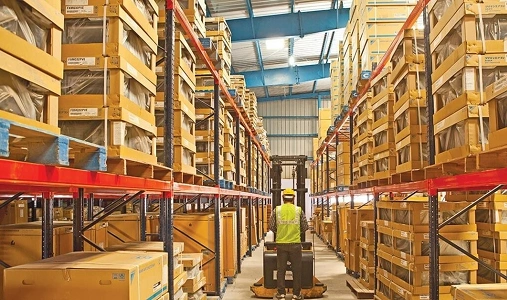
The industry structure has shifted decisively toward organised, large-format facilities. Earlier, small and fragmented godowns dominated the landscape. In 2026, demand is increasingly concentrated in Grade-A warehouses with features such as high clear heights, wide column spacing, fire safety systems, automation readiness, and strong connectivity to highways.
The market is now split into:
- Grade-A warehouses (institutional, compliant, large-scale)
- Grade-B/C warehouses (older, fragmented, cost-driven)
Institutional developers, logistics parks, and REIT/InvIT-backed platforms are playing a growing role in supply creation.
Growth Drivers in 2026
1. E-commerce and Quick Commerce Expansion
E-commerce remains the single largest growth driver for warehousing. Online retail, quick commerce, and omni-channel models require dense networks of fulfilment centres and last-mile warehouses.
Faster delivery promises—same-day and next-day—have increased demand for urban and near-urban warehouses, especially around major cities.
2. GST-Led Supply Chain Consolidation
The implementation of GST has permanently altered supply chain design. Companies have moved away from multiple small state-level warehouses to fewer, larger regional hubs. This consolidation has increased demand for high-quality, centralised warehousing facilities.
Efficiency, rather than tax optimisation, now drives warehouse location decisions.
3. Manufacturing and “Make in India” Push
Growth in domestic manufacturing has boosted demand for warehousing across raw materials, work-in-progress storage, and finished goods distribution. Sectors such as electronics, automobiles, pharmaceuticals, and consumer goods are expanding warehouse footprints.
Warehousing is increasingly integrated with industrial parks and manufacturing clusters.
4. Growth of Third-Party Logistics (3PL)
Outsourcing logistics has become common across industries. 3PL players require large, standardised warehouses that can serve multiple clients. This has accelerated demand for flexible, scalable warehousing infrastructure.
5. Cold Storage and Agri Warehousing
Cold-chain and agri warehousing are expanding steadily. Food processing, pharmaceuticals, fisheries, and fresh produce supply chains require temperature-controlled storage, driving investment in modern cold warehouses.
Although still underpenetrated, this segment has strong long-term potential.
Segment-wise Performance
a. Grade-A Warehousing
Grade-A warehouses are the fastest-growing segment. They attract higher rentals, long-term leases, and institutional capital. Most new supply additions in 2026 fall into this category.
b. Multi-Client Logistics Parks
Large logistics parks offering warehousing, trucking, and value-added services are gaining popularity. These parks benefit from economies of scale and better infrastructure access.
c. Urban Fulfilment Centres
Smaller warehouses closer to consumption centres support quick commerce and same-day delivery. While space is limited and rentals are high, demand remains strong.
d. Cold Storage Warehouses
Cold storage capacity is increasing, but demand continues to outpace supply. Modern, energy-efficient cold warehouses are preferred over traditional cold stores.
Competitive Landscape
The warehousing industry is increasingly dominated by organised developers and institutional platforms. Large logistics and real estate players are expanding portfolios across multiple cities and corridors.
Private equity and long-term investors are actively funding warehouse assets due to stable returns and long lease tenures. The presence of global and domestic logistics firms has professionalised operations and standards.
Key Challenges in 2026
1. Land Acquisition and Location Constraints
Securing large, contiguous land parcels near highways and cities is difficult and expensive. Zoning issues and local approvals can delay projects and increase costs.
2. Rising Construction and Financing Costs
Steel, cement, and labour costs remain elevated, raising development costs. While rentals are rising, margins can still be tight, especially for speculative projects.
3. Infrastructure Bottlenecks
Road connectivity, power availability, and drainage remain inconsistent in some emerging warehouse clusters. Infrastructure gaps can limit operational efficiency.
4. Skill Shortages
Modern warehouses require trained manpower for operations, automation, inventory management, and safety compliance. Skill availability has not kept pace with rapid expansion.
5. Fragmented Legacy Stock
A large base of older, non-compliant warehouses still exists. Upgrading or replacing this stock is slow due to cost and ownership fragmentation.
Structural Shifts Defining 2026
Several long-term trends are reshaping the warehousing industry:
- Shift from unorganised godowns to Grade-A facilities
- Integration of warehousing with logistics and transport
- Increased automation and digital warehouse management
- Stronger role of institutional capital
- Growth of cold-chain and urban fulfilment centres
The industry is moving from space-driven growth to service- and efficiency-driven growth.
Forecast: Warehousing Industry Outlook (2026–2030)
Short-Term Outlook (2026–2027)
- Strong demand from e-commerce and 3PL players
- Continued addition of Grade-A warehouse stock
- Rising rentals in prime logistics hubs
Medium-Term Outlook (By 2030)
By 2030, India’s warehousing industry could exceed ₹4 trillion in size, with total stock crossing 700 million sq. ft. Growth will depend on:
- Infrastructure development along freight corridors
- Expansion of cold-chain capacity
- Technology adoption and automation
- Stable regulatory and land policies
Final Takeaway
In 2026, India’s warehousing industry is no longer an invisible support function—it is a strategic enabler of consumption, trade, and manufacturing. Demand is strong, capital is available, and quality standards are rising.
The next phase of growth will belong to developers and operators who can secure the right locations, build compliant and flexible facilities, and integrate technology into everyday warehouse operations.