In 2026, India’s rice industry stands as one of the most strategically important pillars of the national economy. Rice is not just a food crop; it is central to food security, rural livelihoods, inflation control, and export diplomacy. From smallholder farmers and procurement agencies to millers, exporters, and global buyers, the rice value chain touches millions of lives across the country.
What defines the rice industry in 2026 is scale combined with tight policy oversight. India remains the world’s largest rice exporter and one of the biggest producers, yet the sector operates under constant regulatory, climatic, and geopolitical pressures. Government procurement policies, water availability, climate risks, and global trade dynamics all shape the industry’s performance.
This article breaks down the current size of India’s rice industry in 2026, the factors driving its growth, the challenges it faces.
Quick Overview: Rice Industry in India (2026)
| Aspect | Status |
| Total industry size | ₹9.5–10.0 trillion |
| Annual growth rate | ~4–5% |
| Global position | Largest exporter, 2nd largest producer |
| Annual production | ~135–138 million tonnes |
| Export volume | ~20–22 million tonnes |
| Major varieties | Non-basmati, basmati |
| Procurement role | Very high (government-led) |
| Industry stage | Policy-driven stability |
Industry Size and Structure (2026)
By 2026, India’s rice industry is estimated to be worth ₹9.5–10.0 trillion, covering cultivation, procurement, milling, storage, distribution, and exports. Rice occupies the largest share of India’s foodgrain output and is cultivated across diverse agro-climatic regions.
The industry structure is deeply layered:
- Farm-level production, dominated by small and marginal farmers
- Government procurement and storage, led by agencies such as Food Corporation of India
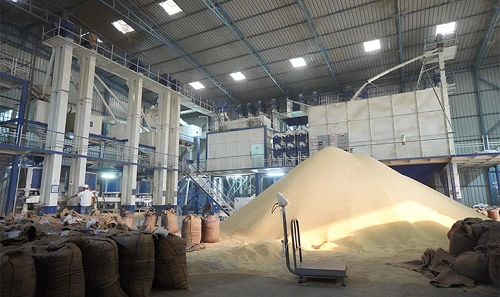
- Rice milling, ranging from small hullers to modern integrated mills
- Domestic distribution through public distribution and open markets
- Exports, handled by private traders and large exporters
Non-basmati rice accounts for the bulk of production and domestic consumption, while basmati rice contributes disproportionately to export value.
Key Growth Drivers in 2026
1. Food Security and Public Distribution
Rice remains the backbone of India’s food security system. Large-scale government procurement for public distribution ensures stable demand regardless of market conditions.
This policy-backed demand provides income assurance to farmers and price stability to consumers.
2. Strong Export Position
India continues to dominate global rice exports, supplying both premium basmati and affordable non-basmati varieties. Demand from Africa, the Middle East, and parts of Asia remains strong.
India’s ability to supply large volumes at competitive prices gives it strategic importance in global food trade.
3. Population Growth and Consumption Stability
Rice consumption remains stable across income groups. While dietary diversification is occurring, rice remains a staple food for a majority of Indian households.
Urbanisation has not significantly reduced rice consumption, supporting steady domestic demand.
4. Milling and Storage Modernisation
Gradual investment in modern milling, grading, and storage infrastructure is improving rice quality, reducing post-harvest losses, and supporting export competitiveness.
States with better infrastructure are capturing higher value.
5. Government Support to Farmers
Minimum support prices (MSP), input subsidies, and assured procurement continue to incentivise rice cultivation, especially in key producing states.
Segment-wise Performance
a. Non-Basmati Rice
Non-basmati rice dominates both production and consumption. It is central to food security and exports to price-sensitive markets.
Prices are heavily influenced by government policies and export controls.
b. Basmati Rice
Basmati rice is a premium segment with strong export demand. It contributes significantly to export earnings despite lower volumes.
Quality, aging, and branding play a critical role in this segment.
c. Rice Milling
Milling remains fragmented. While large modern mills are gaining share, many small mills continue to operate with limited technology and efficiency.
d. Rice Exports
Exports are sensitive to global supply conditions, trade restrictions, and domestic availability. Policy decisions can rapidly alter export flows.
Competitive Landscape
India competes globally with Thailand, Vietnam, Pakistan, and Myanmar. However, India’s scale and cost competitiveness give it an edge, particularly in non-basmati rice.
Domestically, competition among millers and traders is intense, but pricing power remains limited due to government intervention and global benchmarks.
Branding is more developed in basmati rice, while non-basmati remains largely commoditised.
Key Challenges in 2026
1. Water Stress and Sustainability
Rice is a water-intensive crop. Declining groundwater levels and erratic monsoons pose long-term sustainability risks, especially in northern states.
2. Policy and Export Uncertainty
Frequent changes in export policies, duties, or bans create uncertainty for exporters and global buyers. This affects long-term trade relationships.
3. Rising Input Costs
Costs of fertilisers, labour, electricity, and irrigation are rising. While MSP provides some protection, margins remain under pressure for farmers.
4. Storage and Logistics Losses
Despite improvements, post-harvest losses due to inadequate storage and logistics persist, affecting overall efficiency.
5. Climate Variability
Extreme weather events—floods, droughts, and heatwaves—pose increasing risks to rice yields and production stability.
Structural Shifts Visible in 2026
Several long-term trends are shaping the rice industry:
- Gradual shift toward water-efficient varieties
- Increased focus on sustainable farming practices
- Modernisation of milling and storage
- Stronger export branding in basmati rice
- Continued dominance of government procurement
The industry is evolving slowly, constrained by policy and sustainability realities.
Forecast: Rice Industry Outlook (2026–2030)
Short-Term Outlook (2026–2027)
- Stable production and procurement volumes
- Strong export demand with policy sensitivity
- Continued pressure on water resources
Medium-Term Outlook (By 2030)
By 2030, India’s rice industry could reach ₹12 trillion in size. Growth will depend on:
- Adoption of water-saving cultivation methods
- Policy stability in exports
- Infrastructure improvements in storage and milling
- Climate resilience measures
Value growth will remain moderate, driven more by exports and quality improvement than by volume expansion.
Final Perspective
In 2026, India’s rice industry is massive, essential, and carefully managed. It balances the needs of farmers, consumers, and global markets under constant scrutiny.
The future of the sector lies not in producing more rice, but in producing it more sustainably, efficiently, and predictably—ensuring that India remains a reliable food supplier at home and abroad while protecting its natural resources for the long term.